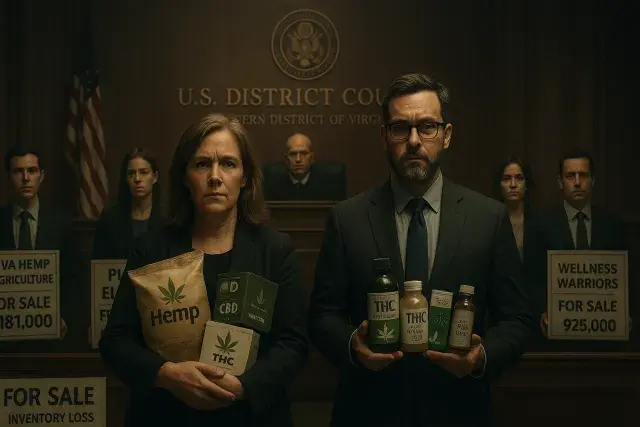
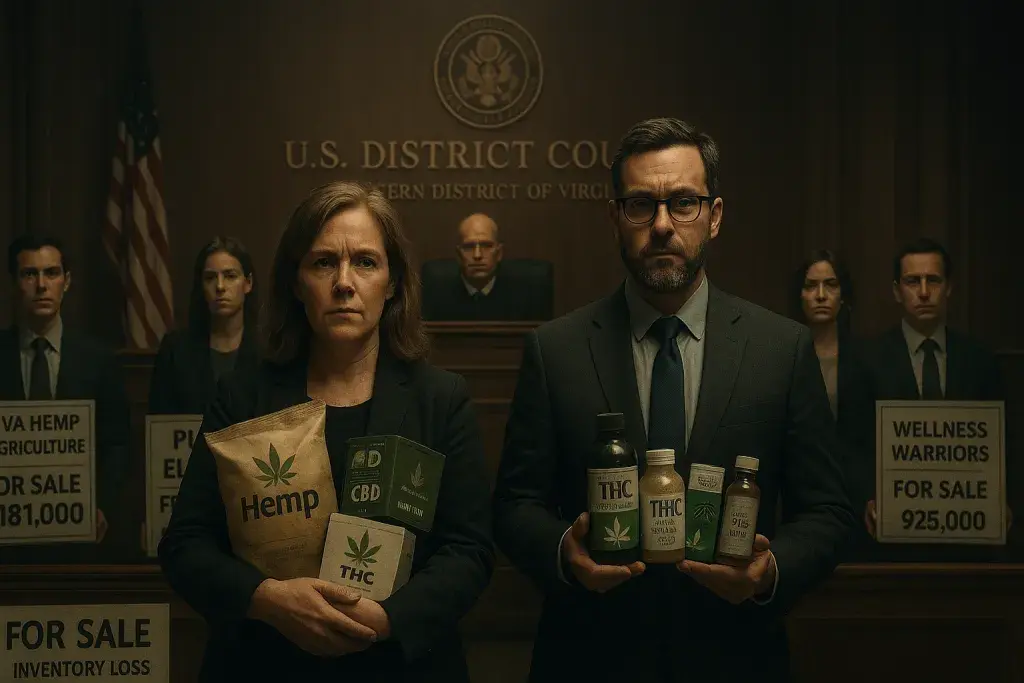
Seven Virginia hemp businesses filed suit July 31 in the U.S. District Court for the Western District of Virginia, asking a federal judge to block a budget provision that eliminates a long-standing exception allowing consumable hemp products to exceed 2 milligrams of THC per package when paired with at least 25 times as much CBD. Without that ratio exception, the state's existing 2-mg cap and 0.3 percent total THC concentration limit apply across the board, starting August 15. The plaintiffs - including District Hemp Botanicals, Nova Hemp & Agriculture, Redfern Hemp Co., Pure Elkton Manufacturing, Cypress Hemp II, Wellness Warriors and Simply Hemp - say the change was announced with roughly 40 days' notice, not nearly enough time to reformulate SKUs, renegotiate manufacturing agreements, redesign compliant packaging or liquidate inventory that will no longer be legal to sell.
The mechanics of the dispute matter for anyone running a retail operation that touches THC or CBD products, whether in a hemp storefront or a licensed dispensary. Compliance windows, inventory write-downs and vendor renegotiations are the daily grind of regulated cannabis retail, and Virginia's compressed timeline is a case study in how abruptly a state can rewrite the rules governing a product category. Operators managing wholesale menus and batch-level compliance logs already know that a sudden reclassification doesn't just affect what's on the shelf - it ripples through leases, staffing plans and creditor obligations. The same operational discipline that keeps a dispensary's point-of-sale terminals and seed-to-sale tracking current in Virginia would look familiar to operators using a point-of-sale for North Dakota dispensaries, where state-specific tracking and reporting requirements demand similarly tight coordination between compliance staff and store management.
District Hemp founder Barbara Biddle says the company has about $10,000 in now-unsellable inventory against more than $181,000 in outstanding obligations to creditors - the kind of mismatch that turns a routine reformulation into a solvency problem. Cypress Hemp reports that products affected by the rule change account for roughly 95 percent of its revenue. Simply Hemp projects losses near $225,000 this year and expects to close its Collinsville store. These aren't abstract compliance costs; they're line items that show up on a balance sheet within weeks, not fiscal quarters.
Why Virginia Moved on the THC Loophole
State officials frame the change as consumer protection, not corporate maneuvering. A spokesman for Gov. Abigail Spanberger said untested, highly intoxicating products have circulated for years in vape shops and convenience stores that operate outside the licensing, testing and age-verification framework governing marijuana dispensaries. That's a real regulatory gap - hemp retailers selling THC-infused beverages and edibles under the 25-to-1 exception have not been subject to the same seed-to-sale tracking or point-of-sale age-gating protocols that licensed cannabis operators must maintain. Attorney General Jay Jones has signaled his office will defend the law, calling it a framework with "clear standards" and enforcement tools aimed at the illicit market.
The plaintiffs counter that the new standard measures total THC per package without accounting for concentration, serving size or actual intoxicating effect - an argument with some technical merit, since a diluted 12-ounce beverage with a high CBD ratio behaves very differently than a concentrated edible at the same nominal milligram count. They also point to an odd asymmetry: once Virginia's licensed adult-use marijuana market opens on July 1, 2027, a 100-mg THC beverage will be legally sold through the Virginia Cannabis Control Authority's regulated channel, while a far less potent hemp beverage is banned starting this month.
The Compensation and Transition Gap
The lawsuit rests on constitutional claims - unconstitutional taking, due process, equal protection - but the practical ask is simpler: an injunction preserving the 25-to-1 exception while the case proceeds, buying time for either a legislative fix or a compensation framework. Virginia offered no grandfather clause, no sell-through period and no reimbursement mechanism for inventory rendered unsellable overnight. Compare that with California's 2024 approach, which phased in a ban on detectable THC in food and beverages and reported near-universal compliance after inspecting more than 11,000 businesses, or Minnesota's regulatory model, which set clear per-serving and per-package THC limits alongside age restrictions and lab-testing requirements. Virginia's version skips the runway entirely.
What Operators Elsewhere Should Watch
This case lands alongside a separate federal shift: a provision signed into law last year caps finished hemp-derived cannabinoid products at 0.4 mg of total THC per container beginning November 12, a threshold far stricter than Virginia's already-tightened 2-mg limit. Retailers and brands operating across state lines now face layered compliance - state THC caps, federal redefinition of hemp, and a patchwork of testing and labeling rules that vary sharply from Texas's near-total prohibition to Minnesota's more permissive serving-based system. For dispensary operators, wholesalers and compliance teams, the Virginia litigation is a reminder that regulatory certainty in this category remains thin, and that inventory planning, vendor contracts and lease commitments should account for the possibility of abrupt rule changes with little or no transition period.