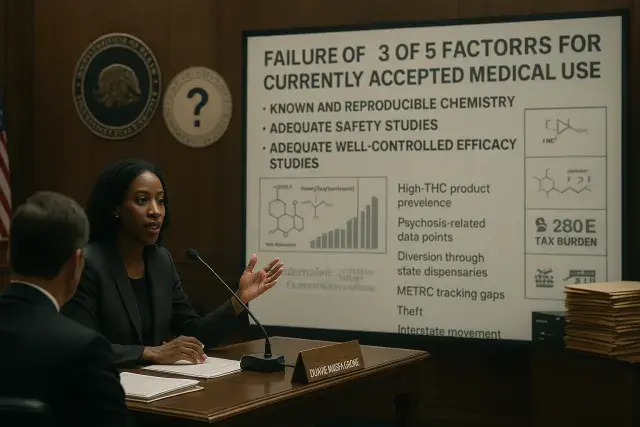
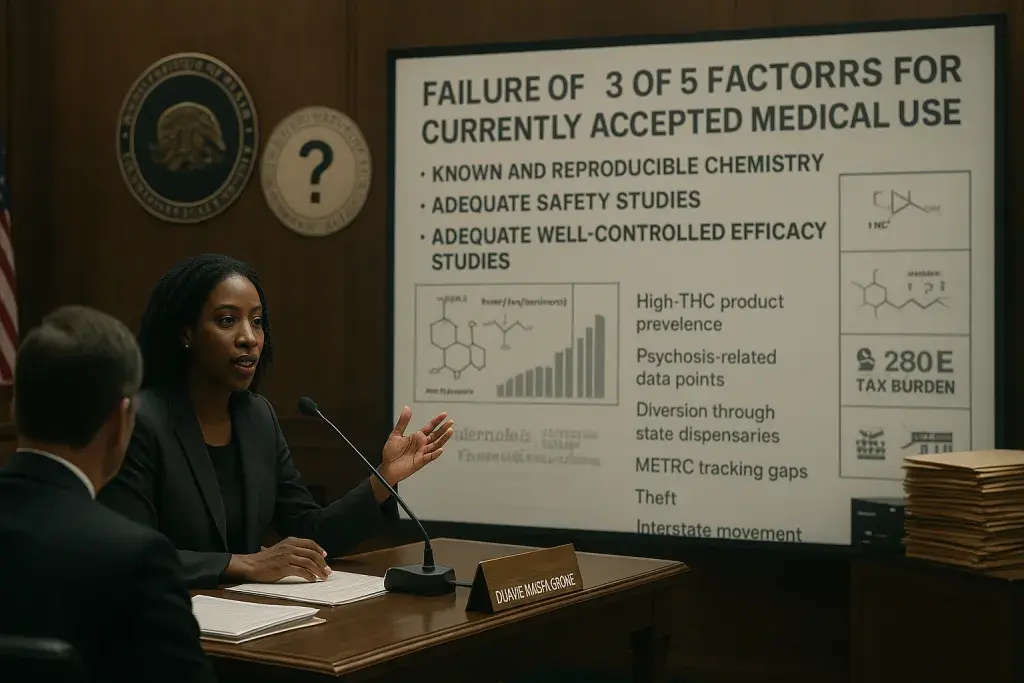
A federal pharmacologist who authored the Drug Enforcement Administration's 2024 Scientific Data Review testified under subpoena during the ongoing marijuana rescheduling hearing - and her conclusions may fundamentally complicate the regulatory path toward Schedule III. Dr. Luli Akinfiresoye, a pharmacologist in DEA's Drug and Chemical Evaluation Section, acknowledged under questioning that marijuana failed the first three factors of DEA's traditional five-part test for determining "currently accepted medical use." That testimony puts the agency's own scientific record in direct conflict with the Department of Health and Human Services recommendation that triggered the proposed rescheduling.
For the cannabis industry - dispensary operators, multi-state operators, wholesalers, compliance officers - this proceeding has been watched closely as a signal of where federal policy is headed. Rescheduling marijuana from Schedule I to Schedule III would alter the 280E tax burden that prevents licensed cannabis businesses from deducting ordinary business expenses, change federal research access, and reshape how financial institutions assess the risk of serving plant-touching operators. Resources like indicaonline.com track how regulatory shifts affect dispensary technology and operations - and a stalled or reversed rescheduling would carry real operational consequences for the businesses that have built around an anticipated change in federal posture. The testimony introduced this week makes that outcome considerably less predictable.
What the DEA's Own Scientist Actually Said
According to Duane Boise, CEO of MMJ International Holdings, who observed the hearing testimony, Dr. Akinfiresoye concluded that marijuana failed three of the five factors in DEA's longstanding framework for evaluating currently accepted medical use: known and reproducible chemistry; adequate safety studies; and adequate and well-controlled efficacy studies. Under DEA's historical application of that framework, failure on any single factor weighs against a finding of accepted medical use. Failing three is not a minor discrepancy.
Perhaps the most pointed finding concerned chemistry. According to testimony drawn from DEA's own Scientific Data Review, botanical marijuana's chemical composition varies to a degree that standardized dosing cannot reliably be established - the plant does not possess a consistent and reproducible chemical profile capable of producing predictable clinical effects. That's not a fringe position. It mirrors the foundational premise of FDA drug development, where reproducible chemistry, controlled manufacturing, and batch-to-batch consistency are baseline requirements before a substance is approved for prescription use nationwide. The testimony also addressed public health dimensions: increasing prevalence of high-THC products, potential drug interactions, psychosis-related concerns in scientific literature, and the explicit point that recommendations made by dispensary staff do not constitute medical advice.
A Scientific Divide Inside the Federal Government
Here's what's striking: this is not a situation where an outside party introduced contradictory evidence. The federal government placed its own pharmacologist under oath, and she testified that marijuana failed DEA's traditional scientific standard - the same standard the agency has applied historically to every other substance under review. At the same time, HHS recommended Schedule III using a different, newer two-part framework that emphasizes widespread medical use and professional recognition. DEA's own scientist acknowledged, under cross-examination, that her evaluation disagreed with HHS's conclusions on currently accepted medical use.
That divergence matters procedurally. The proposed Schedule III rule is built on the scientific foundation HHS provided. If DEA's own scientific review - produced internally, by DEA staff, applying DEA's own analytical framework - reached materially different conclusions, reviewing courts would have a substantial question to examine: on what scientific basis can the agency adopt a regulatory conclusion that its own expert rejected? Agencies generally must justify their decisions with reasoned explanations grounded in their own record. A certified transcript of this testimony would become part of that record.
Diversion, Dispensary Operations, and the Regulatory Picture
The hearing also surfaced the diversion analysis that HHS apparently did not include in its recommendation. DEA's Scientific Data Review, according to testimony, identified state medical and recreational programs as significant sources of diversion - through individuals with lawful access, theft from dispensaries, household redistribution, and interstate movement. Dispensary operators are already familiar with the compliance architecture designed to minimize diversion risk: seed-to-sale tracking systems, METRC integration, inventory reconciliation, and strict point-of-sale controls. Those systems exist precisely because regulators treat diversion as a live concern, not a resolved one. The DEA review's inclusion of this analysis - and HHS's apparent omission of it - reflects a genuine methodological gap between the two agencies, not simply a difference in policy preference.
What this proceeding ultimately demonstrates is that the marijuana rescheduling debate is not only a political or policy question. It is a dispute about which scientific methodology the federal government will use to evaluate cannabis - and whether that methodology will align with the pharmaceutical standards applied to every other regulated substance. For licensed cannabis businesses, the practical stakes are significant: 280E exposure, banking access, interstate commerce restrictions, and the long-term regulatory architecture of the industry all hinge, in part, on where marijuana sits in the federal scheduling framework. The proceeding isn't over. But the testimony of DEA's own scientist has placed the evidentiary record in a position that is much harder to resolve cleanly than many in the industry anticipated.