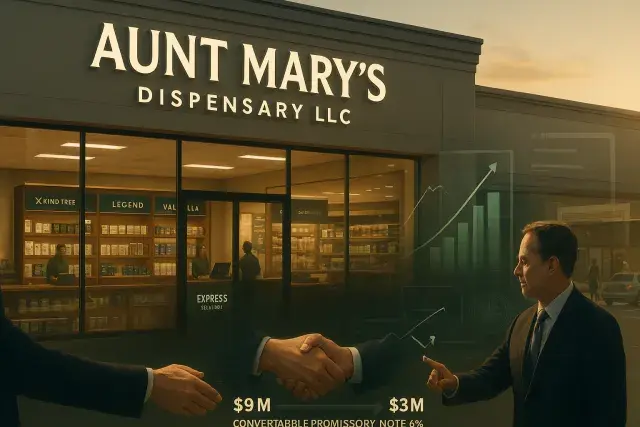
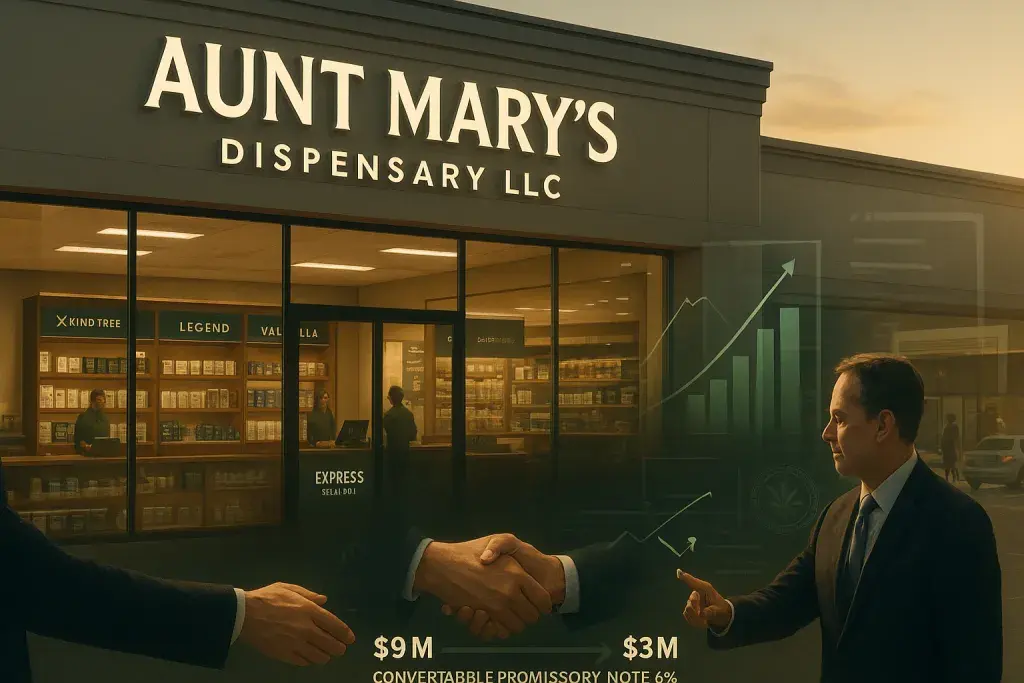
TerrAscend has signed an option agreement to purchase Aunt Mary's Dispensary LLC in Flemington, New Jersey - a move that would bring the multi-state operator's Garden State retail count to five locations. The deal, valued at $9 million in total, is structured as a phased transaction and is subject to regulatory approval. For a company that has been signaling disciplined retail expansion, this acquisition fits the pattern: an accretive asset with established revenue, limited local competition, and room to improve margins through brand integration.
The financial structure is worth examining. TerrAscend will pay $3 million via a five-year unsecured convertible promissory note at 6.0% interest for an option to acquire a 35% stake, with $6 million in cash due upon exercise of that option. It's a staged approach - one that manages near-term capital outlay while locking in the asset. Aunt Mary's is reportedly generating over $10 million in annualized revenue, which means the headline price looks lean against its revenue run rate. Whether the deal pencils out long-term depends heavily on what TerrAscend can do with the margin profile once its own brands - Kind Tree, Legend, Valhalla, and Cookies - are on the shelves. Operators in other regulated adult-use markets, from Illinois to states where Montana cannabis POS infrastructure is still being built out, have seen firsthand how vertical integration can shift gross margin from low-teens to something considerably more defensible when a house brand displaces third-party wholesale.
Aunt Mary's opened in February 2023 and sits in The Shoppes at Flemington - a high-traffic retail corridor that offers exactly the kind of consumer visibility a dispensary needs to sustain volume without heavy reliance on discounting. The 5,200-square-foot footprint is substantial; it gives TerrAscend enough floor space to merchandise a full SKU range, run separate express and consulting budroom lanes, and potentially support delivery dispatch if New Jersey's regulatory framework allows it from that location. Limited nearby competition is a genuine asset in adult-use cannabis, where store proximity and license density directly affect market share.
What Vertical Integration Actually Does to Dispensary Economics
The margin argument behind this deal is straightforward, even if execution isn't. In a regulated adult-use market like New Jersey, a dispensary that sources entirely from third-party cultivators and processors is fully exposed to wholesale pricing pressure. When a multi-state operator introduces its own branded products - cultivated, processed, and packaged through its own licensed entities - it effectively removes that wholesale markup from the cost stack. The savings can be redirected into competitive retail pricing, staff training, or simply held as margin improvement. TerrAscend's executive chairman Jason Wild explicitly cited this mechanism, pointing to a "clear opportunity to enhance margins through vertical integration."
That's not a promotional claim - it's a standard playbook in cannabis retail, and it works when the operator's production capacity is sufficient and the brands command consumer recognition. The catch is execution timing. Regulatory approval for the transaction itself must come first, and then product flow changes require their own compliance steps: updated wholesale agreements, amended license filings, and adjustments to seed-to-sale tracking records. None of that is insurmountable, but it means the margin story plays out over quarters, not weeks.
New Jersey's Regulatory Context and Diverse Ownership Requirements
TerrAscend noted that the transaction conforms to New Jersey's regulatory framework, which facilitates investment opportunities for businesses with diverse ownership. This matters operationally. New Jersey's Cannabis Regulatory Commission has specific rules governing ownership changes, transfer of interest, and investment in licensed dispensaries - particularly those that hold licenses tied to social equity or alternative treatment center designations. Any option agreement, convertible note, or phased acquisition involving a New Jersey cannabis licensee requires regulatory sign-off before the transaction closes. That's not bureaucratic friction for its own sake; it's the mechanism the state uses to ensure that license ownership remains consistent with the conditions under which it was granted.
For other operators watching this deal, the structure - option agreement paired with a convertible note - is a format that has grown more common in regulated cannabis M&A precisely because it gives both parties a defined path while waiting out regulatory timelines. The buyer controls the asset economics without triggering a full ownership transfer on day one; the seller gets capital and certainty. It's a workable structure in states where licensing transfers can take months.
What This Signals for Multi-State Operator Strategy
The broader implication here isn't just about one dispensary in Flemington. TerrAscend's language around "disciplined, accretive transactions" and an active pipeline of additional retail opportunities suggests a deliberate retail-densification strategy in New Jersey - a state where the adult-use market is still developing and where controlling multiple retail doors in a region creates compounding advantages in brand exposure, delivery logistics, and wholesale leverage.
For smaller independent operators in New Jersey, that calculus runs in the opposite direction. A well-capitalized MSO acquiring a neighboring dispensary and switching its shelves to house brands compresses the wholesale market and raises the competitive bar at retail. That's not a hypothetical - it's the structural dynamic that plays out in any consolidated adult-use market. Compliance costs, excise tax obligations, and operational overhead don't shrink as competition increases. The question for independent licensees isn't whether consolidation is happening; it's how they position their product mix, consumer experience, and cost structure before it does.