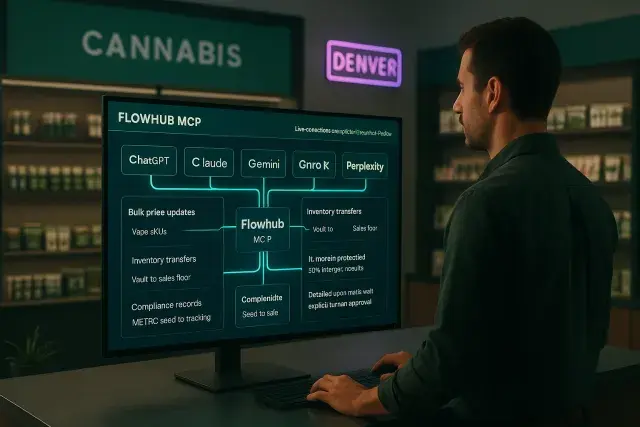
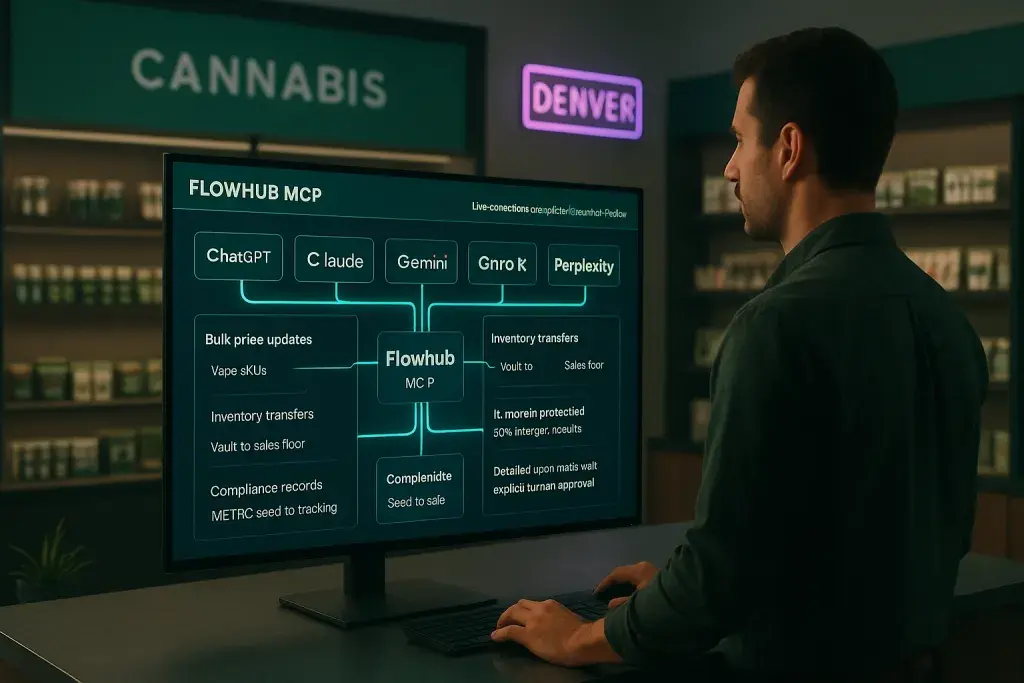
Flowhub, the Denver-based regulated commerce platform, launched Flowhub MCP on July 1, 2026 - a connector built on the open Model Context Protocol standard that lets dispensary operators link their Flowhub account directly to AI tools including ChatGPT, Claude, Gemini, Grok, Perplexity, and Cursor. The announcement marks a meaningful shift in how point-of-sale and back-office systems can interact with consumer AI products, moving the conversation from data visibility to operational execution. For operators already managing compliance pressure, tight margins, and constant SKU churn, that distinction matters.
The practical pitch is straightforward: instead of pulling a report, reading it, deciding what to do, and then manually entering changes, an operator types a plain-language instruction and the system executes it - pending approval. Bulk price updates across vape SKUs, inventory transfers from vault to sales floor, margin-protected clearance deals - these are the kinds of repetitive administrative tasks that consume manager hours every week in dispensary operations. Cannabis retail is a particularly documentation-heavy environment; every inventory movement, price change, and product transfer generates compliance records that seed-to-sale tracking systems like METRC require to remain accurate. The appeal of a tool that handles execution while maintaining a complete audit trail is real, not cosmetic. Operators building multi-location workflows - or any operator thinking about how to run a tighter back office, whether they're on a New York dispensary POS platform or a system purpose-built for another regulated market - are asking the same underlying question: where does the administrative burden actually go?
The MCP standard itself is the architectural detail worth understanding here. Rather than building a proprietary integration for each AI tool, Flowhub adopted an open protocol that allows its platform to communicate with any MCP-compatible AI client. That means Flowhub isn't betting on one AI provider staying on top - a reasonable position given how fast the space has shifted. "The best AI of 2026 won't be the best AI of 2028," said Kyle Sherman, Flowhub's founder and CEO, in the announcement. The open-standard approach reflects a philosophy that regulated retailers should own their data and retain the flexibility to adopt better tools as they emerge, without being locked into a single vendor's AI roadmap.
What Execution-Layer AI Actually Changes for Dispensary Operators
Most cannabis retail software has moved toward analytics dashboards and business intelligence reporting in recent years - tools that surface what's happening but stop short of doing anything about it. The gap between insight and action is where managers spend their time. Flowhub MCP is explicitly positioned at that gap. The connector doesn't just retrieve data; it writes back to the system. That's a meaningful functional difference, and it comes with a corresponding need for guardrails. Flowhub's design requires operator approval before changes are applied, which is the right call in a regulated environment where unauthorized inventory adjustments or pricing errors can trigger compliance exceptions.
Ankit Bhasin, owner of Cannabis Cowboy and an early adopter of the connector, described the workflow his operation has built: Claude analyzes existing store data, generates actionable recommendations, and suggests new promotions daily. "In this industry, we all sell the same products," Bhasin said. "So how do you differentiate yourself?" That observation cuts to the core tension in cannabis retail. Product differentiation at the SKU level is limited - the same brands, the same cultivars, often the same wholesale pricing across competing licensed retailers in a given market. The differentiation that actually moves the needle tends to be operational: faster service, smarter promotions, better inventory positioning, loyalty programs tuned to real purchase behavior. If AI-assisted workflow tools compress the time and skill required to execute on that kind of operational sophistication, smaller single-location operators gain access to capabilities that previously required a dedicated analyst or a much larger team.
Open Platform Strategy and the Compliance Guardrail Question
Flowhub has been building toward what it calls an open operating system for regulated commerce - a unified schema connecting compliance, point of sale, payments, ecommerce, loyalty, and business intelligence under one extensible architecture. The MCP connector is the latest expression of that strategy, and it's notable precisely because it doesn't try to build a proprietary AI layer. Instead, Flowhub exposes its platform to the broader AI ecosystem through a standard protocol. That's a different bet than most POS vendors have made.
The compliance dimension here is worth holding on to. Cannabis retailers operate under state-specific regulations that govern how inventory is tracked, how transfers are logged, how pricing and promotions are recorded, and how sales data is reported to regulators. Any system that writes to a dispensary's operational database - adjusting prices, moving inventory, creating deals - touches compliance-sensitive data. The audit trail that Flowhub says it maintains for every AI-executed action isn't a feature add-on; in most licensed cannabis markets, it's a regulatory requirement. Operators evaluating any AI workflow tool should be asking specifically how those changes are logged, whether the records satisfy their state's seed-to-sale reporting obligations, and what happens when an AI-initiated action produces an inventory discrepancy during an inspection. Those aren't hypothetical edge cases. They're the standard questions any compliance-conscious operator should walk through before connecting an external tool to live operational data.
What Operators Should Consider Before Connecting AI to Their POS
The promise of natural-language control over dispensary operations is genuine. So is the complexity of the environment it's operating in. A few practical considerations for operators thinking about MCP-style integrations:
- Approval workflows matter. Any AI connector that can write to inventory or pricing data should require explicit human confirmation before changes go live - especially in markets with real-time METRC sync requirements.
- Data ownership terms deserve scrutiny. When an operator connects their Flowhub account to a third-party AI tool, understanding what data leaves the platform, how it's processed, and who retains it is a legitimate due-diligence question.
- Margin rules need to be set deliberately. Bhasin's example - creating clearance deals while maintaining at least a 30% margin - illustrates exactly the kind of constraint that should be operator-defined and system-enforced, not left to ad hoc AI judgment.
- Compliance logging must satisfy state requirements, not just internal record-keeping standards. Operators should confirm that AI-initiated actions generate records consistent with their specific regulatory obligations.
None of this diminishes the practical value of what Flowhub is building. Cannabis retail has always been an operationally demanding business running on thin margins and under significant regulatory scrutiny. Tools that reduce the friction of routine administrative work - without compromising the audit trail or the approval chain - have a clear place in a well-run dispensary. The question, as with any new system layer, is whether operators implement it with the same rigor they bring to their compliance obligations. In a licensed cannabis business, the answer to that question has real consequences.