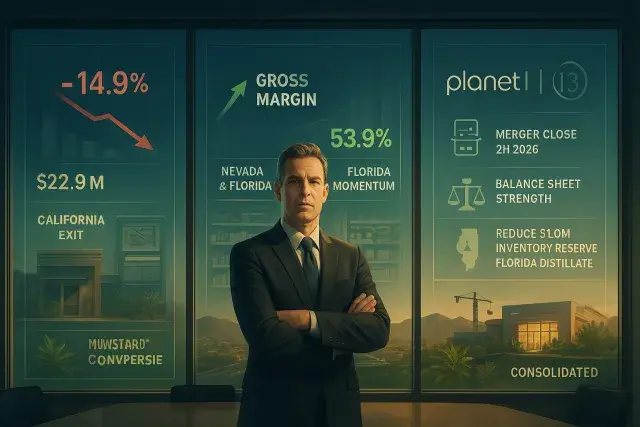
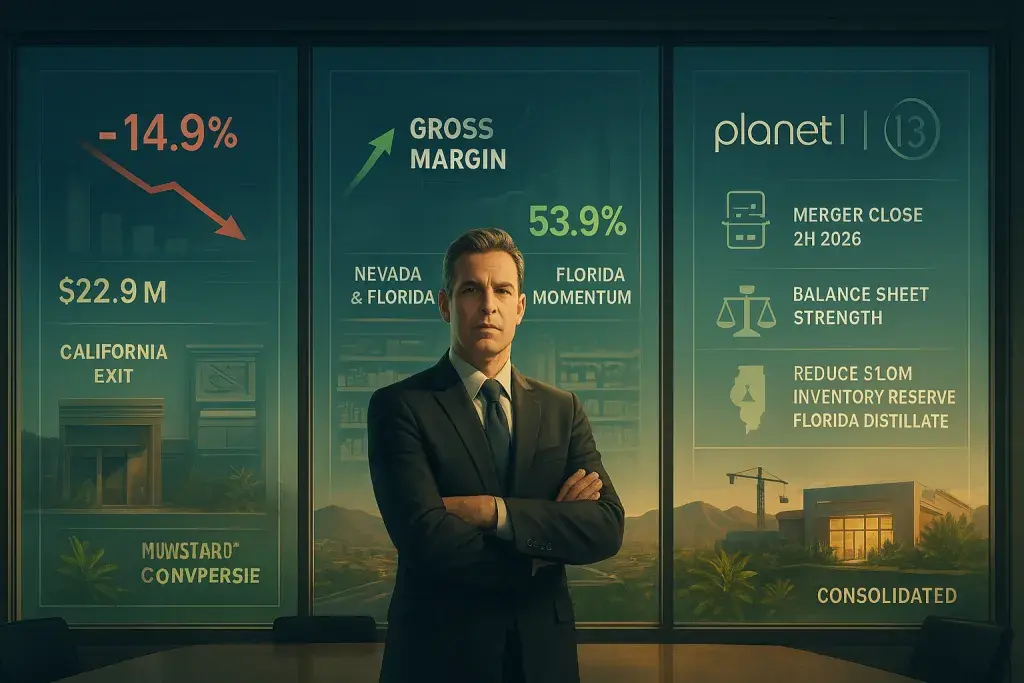
Planet 13 Holdings reported second-quarter 2026 revenue of $22.9 million, down 14.9% from a year earlier, as the multi-state operator absorbed the fallout from its California exit and continued price compression in Nevada and Florida. Yet the numbers underneath tell a more interesting story: gross margin expanded, net loss narrowed sharply, and the company's pending merger with Vireo Growth Inc. now shapes nearly every operational decision. The quarter reads less like a standalone report and more like a bridge document - one final accounting before Planet 13 becomes part of something bigger.
Margin Gains Amid Shrinking Revenue
Gross profit came in at $12.3 million, or 53.9% of revenue, up from 43.4% a year prior. That's a notable swing for a sector where margin compression has been the dominant story for several years running. Some of the improvement came from a $1.0 million reduction in the company's inventory reserve for Florida distillate, as stronger Florida sales worked down excess product on hand - a reminder that inventory reserves are as much a signal of demand forecasting as they are an accounting line item. Strip that adjustment out, and margin still lands at 49.5%, which suggests the underlying gains are structural rather than a one-quarter accounting favor. Total expenses fell 17.7% year over year to $15.2 million, driven by company-wide cost-cutting. In practice, this is what operators do when top-line growth stalls: they stop chasing revenue and start defending margin, tightening procurement, renegotiating vendor terms, and trimming headcount where they can.
California Exit and the Price Compression Problem
Planet 13's departure from California retail and wholesale operations was the single largest driver of the revenue decline, and it illustrates a pattern playing out across the regulated cannabis map. California's combination of high local taxes, a crowded license environment, and persistent illicit-market competition has pushed several multi-state operators to cut losses and redeploy capital elsewhere. Nevada and Florida, meanwhile, are dealing with a different pressure: price compression driven by expanding cultivation capacity and competitive wholesale menus, which squeezes margin even in markets without California's structural headwinds. For dispensary operators watching from adjacent states, the lesson is straightforward - market maturity does not guarantee profitability, and scale alone doesn't fix a pricing environment that's working against you.
Florida Momentum and the BHO Approval
Florida was the bright spot. Revenue there grew 17.1% quarter over quarter, and the company received approval from the Office of Medical Marijuana Use for a BHO extraction facility in May, alongside plans for a new Sarasota store announced in July. Extraction licensing matters because it determines whether an operator can produce its own concentrate and vape inventory rather than buying it wholesale, which affects both margin and supply chain control. For a medical-only market like Florida, where product formats and dosing remain more tightly regulated than in adult-use states, in-house extraction capacity is a meaningful lever for cost management.
The Vireo Merger Reshapes the Calculus
Co-CEO Bob Groesbeck was candid that the merger reflects a market that increasingly rewards scale, purchasing power, and balance sheet strength over standalone operation. That's a fair read of where multi-state cannabis has landed. Smaller operators face a cost structure - Section 280E tax treatment, compliance overhead, seed-to-sale tracking obligations, capital-intensive licensing - that rewards consolidation more than it rewards independence. Planet 13 chose not to host a quarterly earnings call given the pending deal, a routine but telling move signaling that management's attention has shifted from quarterly performance narratives to closing mechanics. For shareholders, employees, and the patients and customers who rely on Planet 13's dispensaries in Nevada, Illinois, and Florida, the coming months will be defined less by same-store sales and more by regulatory approval timelines and integration planning.