
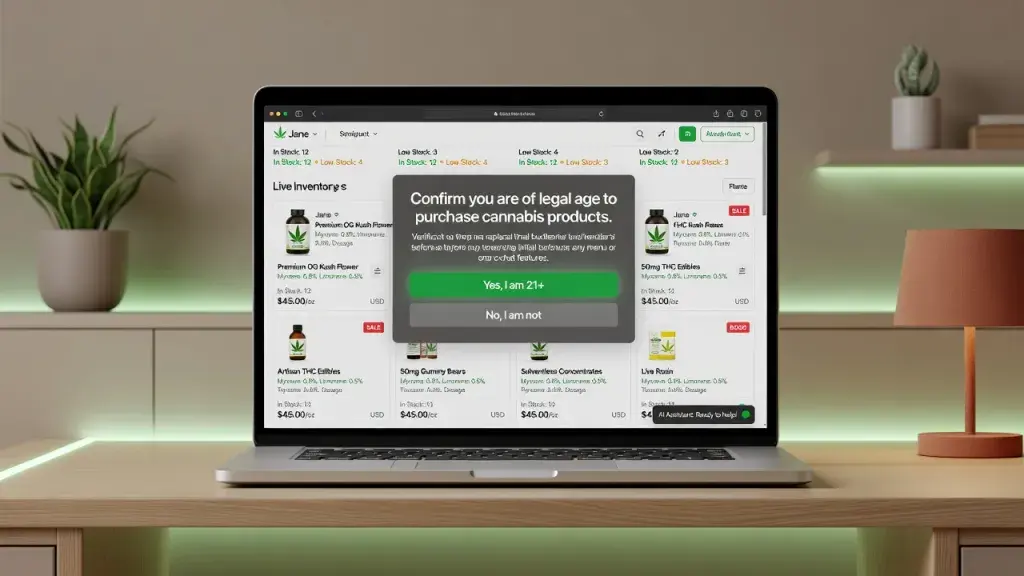
A dispensary's website used to be a digital flyer: hours, address, maybe a menu widget bolted on as an afterthought. That's no longer good enough. With staff turnover running high across the retail cannabis sector, the site itself has to carry institutional knowledge that used to live in one person's head behind the counter - and it has to do that without crossing lines regulators watch closely.
Why the budtender's memory was never a reliable system
Dispensary staffing is volatile. Data from Headset covering June 2021 through May 2022 found that roughly 55 percent of budtenders who worked at any point during that period had left by its end, across the US and Canadian markets it tracked. That's not a minor staffing wrinkle - it's a structural problem for any shop that relies on floor staff to answer product questions consistently and compliantly. The person who knew the inventory, the terpene profiles, or the current promotion in March may be gone by summer. A website that only shows a static grid of products, written once and left alone, inherits the same fragility. The fix isn't a better product description. It's connecting the public-facing site to the same live menu data - typically pulled through a platform like Jane - that drives point-of-sale and inventory systems in the back room.
Three jobs a compliant dispensary site actually has to do
Strip away the marketing talk and a dispensary website has exactly three operational jobs. First, the menu page: gate it with an age check before any product information loads, and make sure what's displayed matches real-time inventory rather than a cached list. Second, the question: shoppers want to know what's in stock, what a product is, and whether a deal is legitimate - and that answer needs to come from live data, with a clear path to a human when the question goes beyond the system's authority. Third, the reorder: any outreach to a past customer is, functionally, a promotional communication, and promotional communications in cannabis retail are not something a system should send unsupervised.
Where automation stops and a compliance decision begins
This is the part operators get wrong most often. A chat tool can draft a reminder, suggest a reorder, or answer a stock question pulled straight from the menu feed. What it cannot do is decide that a given discount is legal to send in a given state, or that a product claim is safe to publish. Advertising restrictions for cannabis vary by state, often more restrictively than for alcohol, and regulators have shown little patience for operators who let automated tools make legal judgment calls. Any promotional message a customer would actually see - text, post, banner, chat offer - should sit in an approval queue until someone at the licensed business signs off.
The line no dispensary site can cross
No page, chat response, or promotional draft should ever suggest a product treats, cures, or prevents a medical condition. That's true whether the words come from a copywriter, a chatbot, or an enthusiastic budtender off script. When a shopper asks a question that edges toward a medical claim, the correct system response is a handoff to staff or a refusal - not a softened version of the claim tucked into a footnote. Age verification belongs in front of all of it, defaulted on, with any change to that setting treated as a deliberate business decision rather than a technical toggle.
- Age gate confirms legal purchasing age before menu or chat content loads
- Live inventory feed, not static copy, answers stock and pricing questions
- Promotional messages route through human approval before reaching customers
- Medical or therapeutic claims are excluded from all automated and written content
For operators running multiple locations, the stakes compound. A single approval queue, a single age-gate policy, and a single compliance standard applied across every storefront keep the business consistent even as floor staff turns over location by location. The website isn't a marketing accessory anymore. It's a compliance control point, and it needs to be built - and governed - like one.