A coalition of marijuana reform groups is pressing Virginia Gov. Abigail Spanberger to use her amendment authority to strip a public consumption penalty increase from the state's newly passed budget legislation-one that would raise the current $25 civil fine for cannabis use in public spaces to $250, a 900 percent jump. The ask comes with new ammunition: enforcement data obtained through FOIA requests showing that Black Virginians are already being charged for public cannabis consumption at more than three times the rate that population share would predict. The budget legislation otherwise contains provisions to legalize recreational cannabis sales, which advocates broadly support-making the penalty provision a sharp-edged carve-out in an otherwise welcome bill.
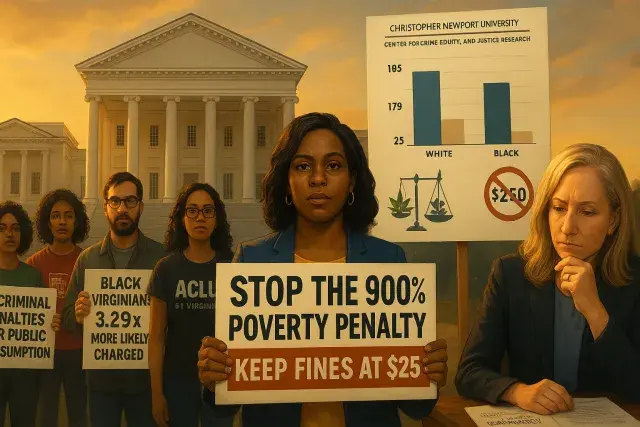
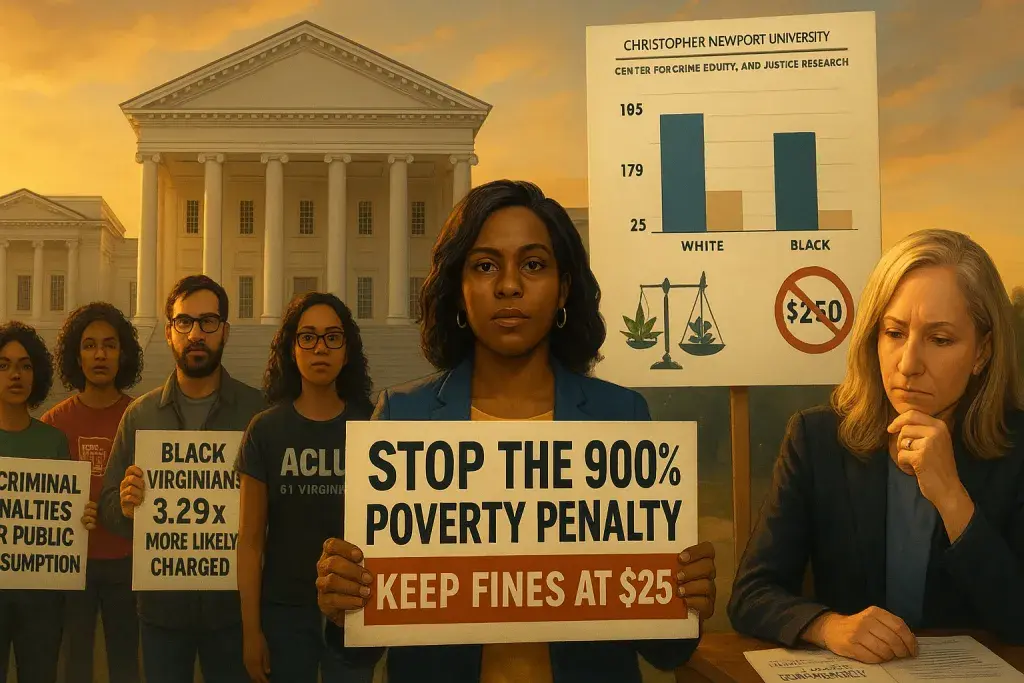
The enforcement numbers, analyzed by Christopher Newport University's Center for Crime, Equity and Justice Research and Policy, are blunt. Since Virginia's noncommercial cannabis legalization took effect in 2021, state records show 185 white individuals and 179 Black individuals have been charged with public consumption. On its face, that sounds close to even. It isn't. Adjusted for Virginia's actual population breakdown, the expected charge distribution would be roughly 255 white individuals and 75 Black individuals if enforcement were applied proportionally. Instead, Black Virginians are approximately 3.29 times more likely to face a public consumption charge than white Virginians. For context, states with mature adult-use markets have long wrestled with this exact enforcement pattern-the experience of jurisdictions deploying compliant cannabis POS in Colorado underscores how the retail and regulatory infrastructure of legalization can outpace the civil liberties component if equity provisions aren't enforced alongside sales frameworks. The Virginia data suggests legalization, without active enforcement reform, doesn't automatically redistribute policing behavior.
Marijuana Justice Executive Director Chelsea Higgs Wise put it plainly: the original legalization law was designed to stop the disproportionate targeting of Black communities. The state's own records say it hasn't done that. Her coalition-which includes the ACLU of Virginia, NORML, Marijuana Policy Project, Drug Policy Alliance, and Latino Cannabis Alliance, among others-sent a letter to Spanberger and legislators framing the fine increase as a "poverty penalty." The argument is structural, not just rhetorical. A $250 civil fine for a low-income person carries consequences well beyond the dollar amount: unpaid fines feed into debt collection systems, complicate rental applications, and can trigger complications in immigration proceedings, educational financial aid, and employment background checks. The organizations are asking Spanberger to hold the line at $25, reject any new criminal penalties for low-level cannabis use, and anchor future policy to data rather than working backward from punitive instincts.
Where the Budget Deal Stands-and What Spanberger Can Actually Do
Spanberger has already signaled she will return portions of the budget for legislative revision ahead of the July 1 deadline-standard procedure in Virginia's amendment process. Advocates are urging her to treat the penalty increase as a substantive issue, not just a technical cleanup. The governor's office has acknowledged that some fixes are required, including removing placeholder question marks left in the legislation as passed. But whether she will use this window to rescind the fine increase is an open question.
Here's the catch: the $250 fine doesn't take effect until July 1, 2026, which gives lawmakers a future session to undo it. Wise and other advocates explicitly rejected that logic. "Postponing harm is not the same as preventing it," she told Marijuana Moment. Delaying a punitive provision doesn't neutralize it-it just sets a calendar for its harm. From a compliance and operational standpoint, licensed cannabis businesses in Virginia also have a stake in how this resolves. An enforcement climate that associates legal cannabis consumption with aggressive policing creates reputational and community trust problems for retailers trying to build customer relationships in exactly the communities being disproportionately cited. Operators in other adult-use states have watched civil-penalty regimes quietly undermine the equity arguments used to build political support for legalization in the first place.
The Broader Deal: What the Budget Legislation Actually Contains
The penalty fight shouldn't obscure what the budget bill does accomplish. After Spanberger vetoed the original adult-use sales legislation-SB 542 and HB 642-earlier this year following a failed reconvened session, she worked with the bill's primary sponsors, Sen. Lashrecse Aird (D) and Del. Paul Krizek (D), on a compromise. The resulting framework now embedded in the budget legislation moves Virginia meaningfully closer to a functioning legal retail market, though on a timeline critics consider overly cautious.
- Legal recreational sales launch date: July 1, 2027 (lawmakers had sought January 1, 2027; the governor pushed for July 1)
- Per-transaction purchase limit: 2 ounces of cannabis or equivalent products, up from the current 1-ounce limit (original bills proposed 2.5 ounces)
- Excise tax: 6 percent at launch, rising to 8 percent beginning July 1, 2029, alongside a 5.3 percent retail sales and use tax
- Local option tax: municipalities may levy an additional tax of up to 3.5 percent
- Public consumption penalty: $250 civil fine, compared to the $25 in current law-lower than the class 4 criminal misdemeanor Spanberger had sought but still a substantial increase
A recent survey found bipartisan majorities of Virginia voters wanted Spanberger to sign the original cannabis bill into law, and disapproved specifically of her move to delay the sales launch. The governor has acknowledged publicly that "a lot of people are not pleased" with her veto, including, she said, friends and family. Her public reasoning has centered on not wanting to rush market implementation-a fair concern in states where early rollouts produced regulatory backlogs and supply chain dysfunction-but the advocacy community isn't buying the framing when it's paired with a 900 percent fine increase.
What This Means for Virginia Cannabis Businesses Watching the Clock
For operators and investors positioning for the Virginia market, the 2027 sales launch gives more lead time than originally anticipated-time to finalize licensing strategy, secure real estate, and build out point-of-sale and seed-to-sale compliance infrastructure. That's not nothing. A compressed launch timeline in a new adult-use state has historically created inventory shortfalls, licensing bottlenecks, and compliance exposure for early retailers. Virginia's phased approach may smooth some of those problems.
What the penalty debate signals, though, is that the social equity architecture of Virginia's legalization still has serious unresolved pressure points. For licensed cannabis businesses, operating in a state where enforcement is statistically concentrated in Black communities isn't a policy abstraction-it's the operating environment. Dispensaries trying to build trust-based retail in urban and mixed-income markets will contend with a customer base that has concrete, data-supported reasons to view the regulatory framework with suspicion. That is a real business problem, separate from the moral and civil liberties dimensions the advocates are raising. The window Spanberger has to use her amendment authority is narrow. What she does with it will say something consequential about which version of legalization Virginia actually intends to build.