
On a Friday morning in Sparks, Nevada - wedged between a sub shop and a pizza place in an ordinary strip mall about five miles east of downtown Reno - Silver State Relief opened its doors and sold legal medical marijuana for the first time in the state's history. That history stretches back to 2000, when Nevada voters approved medical cannabis. The gap between that vote and this moment is not incidental. It is the story.
A Mandate Left Sitting on a Shelf
When Nevadans went to the ballot in 2000, they did something clear and deliberate: they said yes to medical marijuana. What followed was over a decade of legislative inaction - not outright repeal, but the quieter obstruction of omission. The original law contained no mechanism for distribution, no licensed sales, no regulatory framework. Patients who qualified were legally permitted to grow up to 12 plants themselves, or find cannabis through channels that politely went unnamed.
It wasn't until 2013 that the Legislature finally established a system for licensed dispensaries. Even then, the first store didn't open until this month. "The politicians just didn't have the will to do what the people wanted," said state Sen. Tick Segerblom, one of the law's most persistent advocates. "Why the Legislature could not get behind this blows my mind." Fair enough - though the pattern he's describing is not unique to Nevada. Across the country, voter-approved marijuana measures have routinely outpaced the political will required to implement them.
According to the National Conference of State Legislatures, the average time between legislative approval and an operational dispensary runs between nine and eighteen months. Nevada took thirteen years. That's not a delay. That's a choice.
What "Professional" Looks Like at a Dispensary Counter
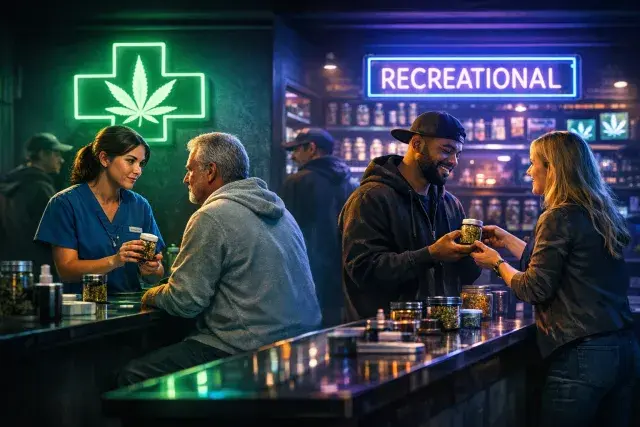
Dana Metz, 64, a retired General Motors worker, was first in line - two hours before the 10 a.m. opening. He cited back pain, insomnia, and anxiety. He left with pre-rolled cigarettes. "Like a kid in a candy store," he said, and then, more substantively: "It's clean. It's very professional. Everything is labeled, and the people are knowledgeable and very helpful."
That word - professional - kept surfacing. Silver State Relief General Manager Aron Swan pointed to the deliberate choice of location: an industrial corridor, clear of residential neighborhoods, churches, and parks. "We've had zero pushback," he said. The roughly 75 customers who showed up that morning dressed in polo shirts, tie-dyes, and button-downs represented, in Swan's framing, the actual medical marijuana patient population - not a demographic caricature, but people managing real conditions. He mentioned a young veteran with PTSD for whom cannabis is, as Swan put it, the only thing that gets him through the day.
A half-ounce cost $195. That price point will draw comparison to the unregulated market, and not always favorably. But what legal dispensaries offer in return - tested product, accurate labeling, knowledgeable staff, and a transaction that doesn't carry criminal exposure - is the actual value proposition.
The Regulatory Architecture Behind the Counter
Nevada's framework is modeled closely on Colorado's system, which had several years of operational data by the time Nevada's Legislature got serious about implementation. The state adopted "seed-to-sale" tracking - a supply chain audit mechanism that follows cannabis from cultivation through point of sale, designed to prevent diversion into the black market and theft from licensed facilities. It's a robust standard, and not universal.
Nevada's Department of Agriculture was also finalizing, at the time of the opening, a pesticide testing protocol screening for 30 to 40 chemicals - the first such program in the country. That matters more than it might sound. Most medical marijuana programs have historically lagged on agricultural quality controls, partly because federal scheduling of cannabis as a Schedule I substance complicates federal regulatory involvement and research. State-level programs are filling that gap unevenly. Nevada's approach is, at minimum, ahead of the curve.
Will Adler, executive director of the Nevada Medical Marijuana Association, described the intent plainly: "We tried to write the law that would be the gold standard for the country." Whether it holds up under the pressure of a larger market - Nevada has distributed most of its 66 dispensary licenses, though the Las Vegas timeline remains unclear due to competing county and state approval processes - is a question the next few years will answer.
What Comes Next, and Why It Won't Wait
Nevada is one of 23 states, plus Washington D.C. and Guam, that permit medical marijuana. Recreational use is legal in Colorado and Washington; Alaska and Oregon have approved it but have not yet opened retail sales. Unless Nevada's Legislature acts before then, voters will face a recreational-use ballot measure in 2016.
The thing is, that vote may well pass - and if it does, the state will need its medical dispensary infrastructure to already be functional, tested, and trusted. The regulatory habits built now, in the relative low-pressure environment of medical sales, are the same ones that will bear weight under a recreational market several times larger. That's not hypothetical. It's what happened in Colorado, where medical dispensaries formed the operational backbone of what became a much larger commercial industry.
For now, Sparks has a dispensary. Nevada has a first. And 15 years of deferred promises have, at least in part, been redeemed - in a strip mall, between a sandwich shop and a pizza place, which is about as unglamorous and real as public policy ever gets.