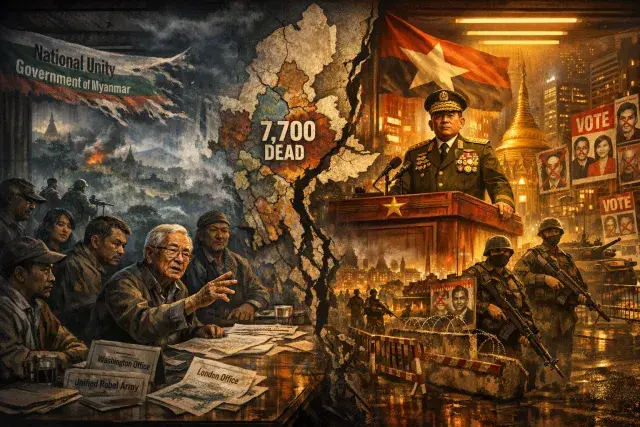
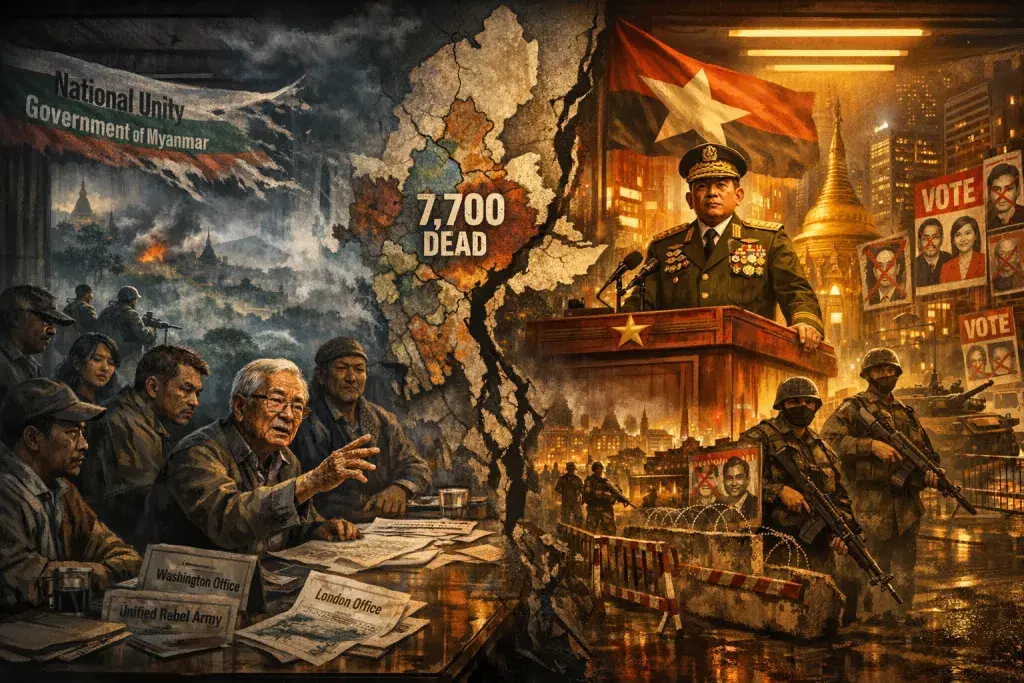
Five years after Myanmar's military junta overthrew the elected government in February 2021, the pro-democracy National Unity Government (NUG)—formed by exiled politicians and civic leaders—struggles for relevance. Envisioned as the nation's sole legitimate voice globally, it now appears sidelined as the junta announces stage-managed elections, highlighting the limits of shadow governance amid ongoing civil war.
Origins and Bold Ambitions
The NUG emerged in the coup's aftermath as a coalition of deposed lawmakers, ethnic leaders, and activists. They established ministries, offices in Washington and London, and outposts in Myanmar's restive border regions. Raising millions, they pledged a unified rebel army from diverse ethnic forces, positioning themselves as a shadow government to challenge junta control.
- Named National Unity Government of Myanmar to signal nationwide aspirations
- Aimed to represent Myanmar internationally against military rule
- Focused on coordinating resistance despite members' exile
Persistent Challenges and Limited Gains
Despite initial momentum, the NUG has faltered. It failed to galvanize global action against the junta's crackdown, which has killed at least 7,700 since 2021. Battlefield coordination with ethnic armies remains incomplete, even as resistance captures territory—the military still holds cities and roughly half the country. Prominent critic U Kyee Myint, an 80-year-old human rights lawyer, describes it as more akin to a civil society group than a revolutionary force, disconnected from grassroots demands.
- Junta controls urban centers and key infrastructure
- Opposition leaders jailed, barred, or in hiding
- Resistance gains significant but fragmented
Implications for Myanmar's Future
As Senior Gen. Min Aung Hlaing's regime prepares a "civilian" facade via sham elections, the NUG risks obsolescence. This underscores broader patterns in protracted conflicts: exile governments often lose traction without unified military control or sustained foreign support. Myanmar's crisis, rooted in decades of military dominance post-independence, could deepen divisions, prolong violence, and deter investment, affecting regional stability in Southeast Asia. True democracy demands bridging urban-rural divides and empowering local ethnic alliances beyond symbolic structures.