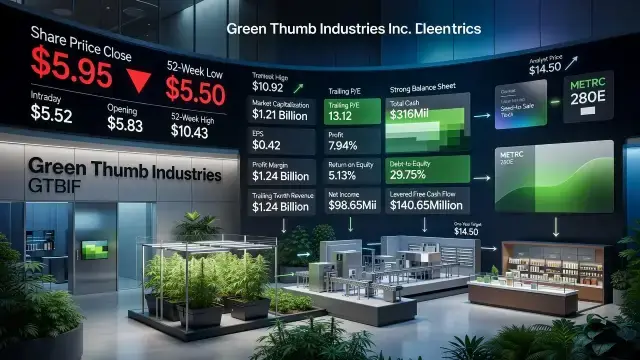
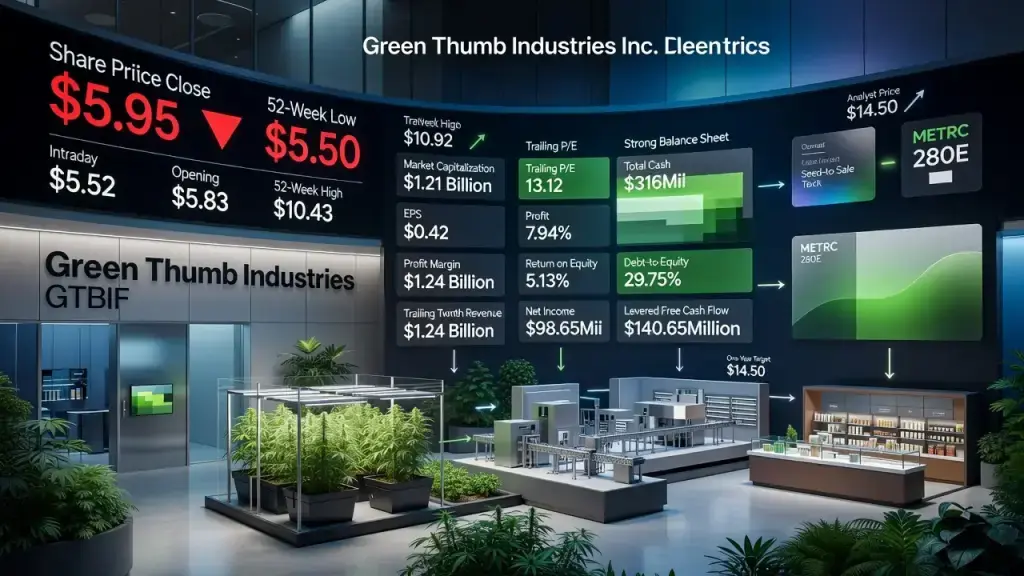
Green Thumb Industries Inc. (GTBIF) closed at $5.95 and opened lower at $5.80, trading within a day's range of $5.52 to $5.93 - well below the stock's 52-week high of $10.43 and inching toward its 52-week floor of $5.50. The multi-state operator's market capitalization now sits at roughly $1.21 billion, a figure that reflects both the broader pressure on cannabis equities and company-specific performance over the trailing twelve months.
What the Numbers Signal for a Multi-State Operator
A trailing P/E of 13.12 against an EPS of $0.42 puts Green Thumb in a different category than many of its cannabis peers, which often post thin or negative earnings. Profit margin of 7.94% and return on equity of 5.13% suggest a company still generating real income, not just revenue growth - no small thing in an industry where plenty of operators are still burning cash to hold shelf space. Trailing twelve-month revenue of $1.24 billion against net income of $98.65 million tells a story of a business with scale, vertically integrated across cultivation, processing, and retail. That vertical integration matters: in a sector where wholesale pricing has compressed in state after state as license counts grow, operators that control their own supply chain - from grow room to dispensary counter - tend to hold margin better than those dependent on third-party wholesale menus.
Balance Sheet Strength Amid Sector Headwinds
Total cash of $316 million and a debt-to-equity ratio near 29.75% give Green Thumb a cushion that many smaller operators simply don't have. Levered free cash flow of $140.65 million is the kind of number that matters more than it gets credit for in cannabis finance circles, because it reflects what's left after the business has serviced debt and funded its own growth - cash that can cover tax bills, including the notorious 280E federal tax burden that strips standard business deductions from plant-touching companies. That's not a small advantage. Operators without that kind of cushion often find themselves squeezed when state excise tax collections tighten or when a market oversupplies and wholesale prices drop faster than retail can adjust.
Reading the Stock Against the Sector's Regulatory Backdrop
The one-year target estimate of $14.50 - more than double the current trading price - reflects analyst expectations that hinge heavily on federal and state-level regulatory movement. Cannabis equities have spent years trading on rescheduling speculation, banking reform chatter, and the slow drip of new adult-use markets coming online. None of that changes the operational reality on the ground: dispensaries still run on seed-to-sale tracking systems like METRC, still face restrictions on interstate commerce, and still can't access normal banking relationships the way a liquor store or pharmacy can. That's the structural tension running underneath every multi-state operator's stock chart. A company can post solid margins and healthy free cash flow, as Green Thumb appears to be doing, and still trade at a steep discount because the federal framework around cannabis remains unresolved.
What This Means for Operators and Investors Watching the Space
For dispensary operators and wholesale suppliers tracking Green Thumb as a bellwether, the figures point to a company managing the fundamentals reasonably well - strong cash position, manageable leverage, positive earnings - while still being priced by the market as a speculative, policy-dependent asset. That gap between operational performance and valuation is worth sitting with. It's a reminder that in regulated cannabis retail, balance sheet discipline and compliant operations only go so far when the surrounding legal framework remains unsettled. Investors and operators alike are, in effect, pricing in regulatory risk as much as business risk.
- Market cap: $1.208 billion, with shares trading near the low end of their 52-week range
- Trailing P/E of 13.12 - notably lower than many unprofitable cannabis peers
- Total cash of $316 million against total debt/equity of 29.75%
- Levered free cash flow of $140.65 million over the trailing twelve months
- No forward dividend, consistent with most cannabis multi-state operators reinvesting cash into expansion and compliance infrastructure