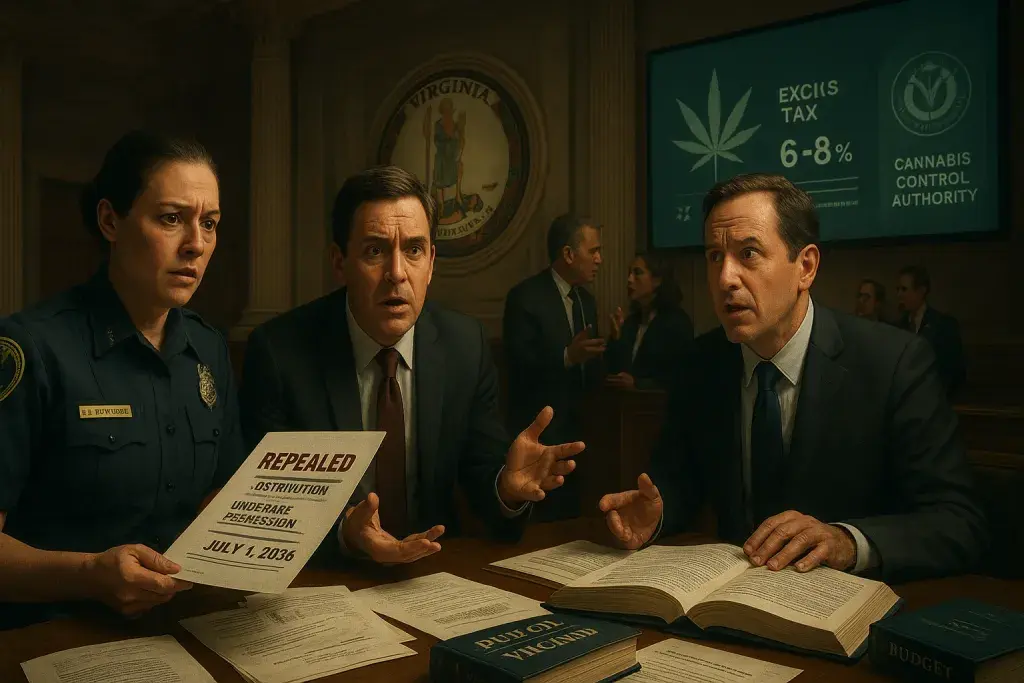
A drafting error buried in Virginia's budget legislation has thrown the state's cannabis enforcement apparatus into genuine confusion, with police commanders, prosecutors, and lawmakers now scrambling to determine which marijuana penalties are actually in effect. The dispute stems from enactment clause language in the budget bill that legalized recreational cannabis sales - language that appears, at least on a plain reading, to have repealed existing criminal penalties for distribution and underage possession without simultaneously replacing them with the new regulatory framework, which doesn't take effect until July 1, 2027.
The practical stakes here are serious. Lt. Brandy A. Molinar of the Virginia State Police sent an internal email this week stating that "as of July 1, 2026, there are no Code of Virginia violations related to marijuana" - a message that, once it circulated publicly, set off a cascade of political recrimination and legal uncertainty across the state. For cannabis operators, compliance officers, and anyone tracking how regulated adult-use markets actually get built, this kind of structural ambiguity is precisely the risk that comes with legislating through budget vehicles rather than standalone statute. Other states have faced their own implementation turbulence; resources like https://indicaonline.com/markets/minnesota/ illustrate how market-specific regulatory timelines and compliance requirements vary sharply even within states that have managed cleaner rollouts than what Virginia is now experiencing.
The Virginia Association of Commonwealth's Attorneys put it plainly: the way the legislation was drafted "invites an argument" about what cannabis laws are currently in force. Nate Green, the commonwealth's attorney for Williamsburg-James City County and a former VACA president, said legislative staff "created a word problem, and word problems go against prosecutors." That's not a rhetorical flourish - it reflects an actual litigation posture. If a defense attorney can plausibly argue that the statute under which a client is charged was repealed on July 1, 2026, a prosecutor in Virginia right now has a real problem.
What the Legislation Actually Did - and Didn't - Do
The budget bill, as enacted, repeals existing Virginia code criminalizing cannabis distribution and possession with intent to distribute, as well as underage possession, without clearly specifying effective dates for those repeals. The new regulatory framework - the one that creates a licensed adult-use retail market with proper age verification requirements, excise taxes set initially at 6 percent and rising to 8 percent after two years, and a 2-ounce public possession limit - doesn't come online until July 1, 2027. That's a full year gap. Whether that gap actually nullifies existing penalties is the question nobody in Richmond seems to agree on.
The Virginia Code Commission has stepped in, updating the state's statutory website to indicate that current penalties remain in effect until July 1, 2027. Del. Marcus Simon (D), who chairs the Commission, said that if the bill's language were followed as written, "an absurd result would have happened," and that the Division of Legislative Services had characterized the situation as an obvious drafting error. The Commission used its authority to correct it - a move that is, as Simon noted, "a fairly routine thing." Whether courts will defer to that administrative correction if it's challenged is a different matter entirely.
The Political Fallout and What It Means for the Market
Democrats who sponsored the legislation - Del. Paul Krizek and Sen. Lashrecse Aird - have pushed back hard, insisting that protections against underage possession and unlawful distribution were never eliminated and that the confusion reflects bad-faith interpretation rather than genuine legal ambiguity. State Police Superintendent Jeffrey Katz said publicly that the agency would "continue to enforce existing laws, in line with the code of Virginia." That's a meaningful clarification from the top of the agency, even if it doesn't resolve the underlying statutory question.
Republicans, meanwhile, have pressed the issue. Former Attorney General Jason Miyares called for a special session and characterized the situation as "reckless governing." Former Del. Tim Anderson made the more inflammatory claim - on social media - that selling marijuana to minors is now legal in Virginia. That claim is not supported by the positions of the Democratic sponsors or the Code Commission's corrective action, but it illustrates the reputational and political cost of a drafting error in a high-visibility regulatory bill.
Here's the catch for licensed operators waiting on the July 2027 launch: this kind of legislative turbulence almost always delays or complicates the regulatory build-out that comes next. The Cannabis Control Authority still has to write and finalize the rules that will govern retail licensing, seed-to-sale tracking requirements, packaging and labeling standards, and age-verification protocols at the point of sale. If the General Assembly convenes a special session to clean up the enactment language - a step Green and Miyares have both called for - that process could consume political bandwidth and staff time that would otherwise go toward standing up the regulatory framework on schedule.
What Operators and Compliance Teams Should Watch
For Virginia-based cannabis businesses - including the medical operators already holding licenses who are positioned to enter the adult-use market - the immediate compliance picture is this: adult-use retail sales are not authorized until July 1, 2027, regardless of the current controversy. Nothing about the drafting dispute changes that. What it does affect is the enforcement environment in the interim, the political durability of the compromise deal, and the likelihood that additional legislative fixes will be required before the market launches.
Compliance professionals tracking this market should document the Code Commission's corrective action and monitor whether any court challenge to that correction materializes. Any case that tests whether the July 1, 2026 budget enactment actually eliminated specific penalty provisions would have direct implications for how Virginia's regulatory agencies interpret their own authority during the run-up to the 2027 launch. That's not an abstract concern - it's the kind of statutory ambiguity that can affect license application timelines, inspection protocols, and enforcement discretion in ways that ripple through to operators' day-to-day compliance obligations.
The broader lesson isn't new, but Virginia is providing a very live demonstration of it: folding major cannabis reform into a budget bill, under deadline pressure, without the full committee hearing process that a standalone bill would receive, creates exactly this kind of risk. The words in the enactment clauses matter - sometimes more than the policy intent behind them.