Mature markets like California and Colorado still generate headlines, but the more interesting story for operators and investors right now sits in two states most people wouldn't have flagged a few years ago. Virginia has cleared the path for an adult-use retail market, and Texas continues to inch its medical program forward despite deep political resistance to broader legalization. Neither state offers instant gratification, but both offer something arguably more valuable: a runway for companies that already hold licenses and operational infrastructure to build a lasting position before competitors show up.
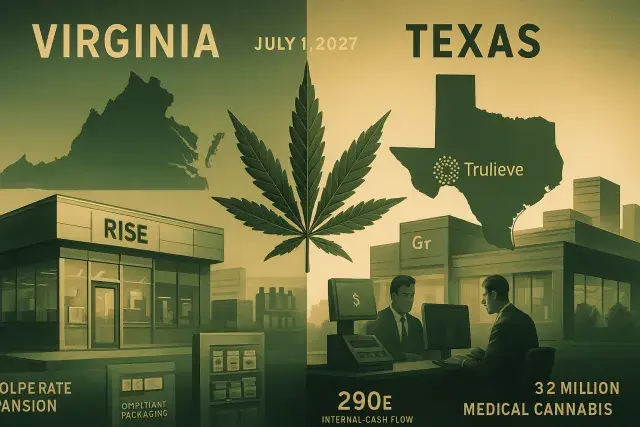
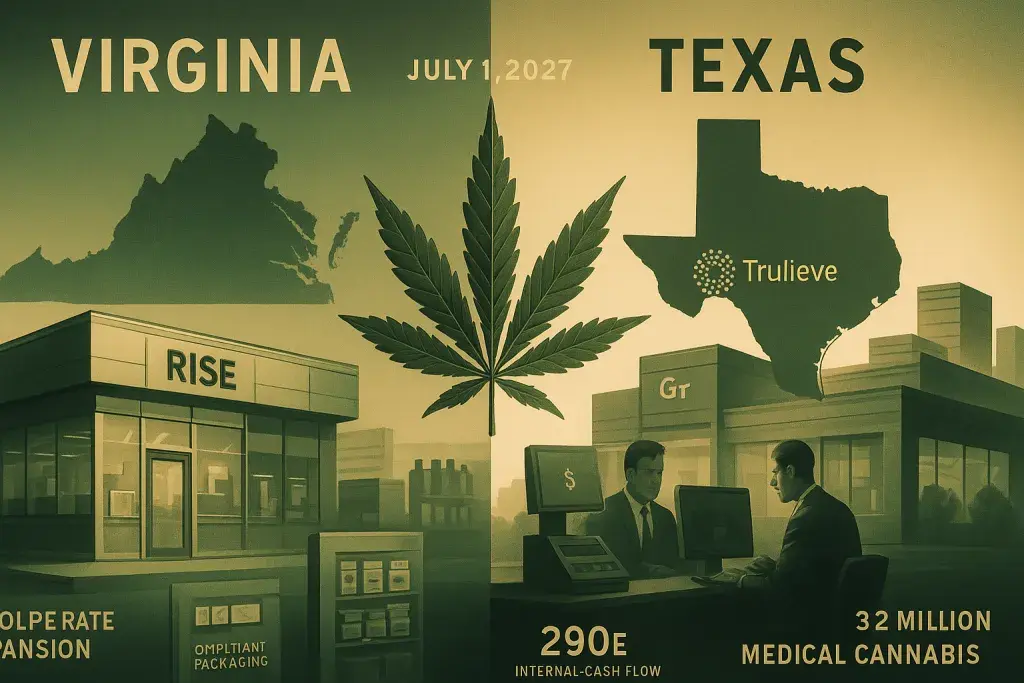
Virginia's move is the more concrete of the two. Adult-use sales are set to begin July 1, 2027, with the state capping the market at up to 350 retail dispensaries - a deliberately controlled rollout that favors operators who already have cultivation and processing in place. That's a very different growth curve than what mature markets experienced, where a flood of licenses and price compression arrived almost simultaneously. Operators who lived through that in Colorado know the pattern well; the early advantage often comes down to infrastructure and back-office systems, the same kind of operational discipline reflected in a modern point-of-sale for Colorado dispensaries, rather than simply being first through the door. point-of-sale for Colorado dispensaries
Virginia's Head Start Favors Existing Medical Operators
Companies already operating in Virginia's medical market through vertically integrated pharmaceutical processor licenses have a meaningful edge heading into adult-use. Green Thumb Industries, which runs one of the state's five such licenses through its RISE dispensaries, already has cultivation, processing, and retail operations running. That matters because building compliant cultivation facilities and passing regulatory inspections takes time - time that new entrants won't have once the adult-use window opens. Verano Holdings holds a similar vertically integrated license in Virginia, giving it comparable positioning. In practice, though, having a license is only half the equation; the operators who scale production, manage SKU expansion, and maintain compliant packaging without disruption will be the ones capturing shelf space when consumer demand shifts from medical to adult-use volumes.
Financial durability matters here too. Cannabis remains constrained by 280E tax treatment and limited access to traditional banking and debt markets, which makes internally generated cash flow a real competitive advantage rather than a nice-to-have. Companies funding expansion through operating cash flow avoid the dilution and expensive financing terms that have hobbled smaller multi-state operators trying to chase new licenses.
Texas Moves Slowly, But Limited Licenses Create Leverage
Texas isn't close to recreational legalization, and nobody should pretend otherwise. But the state's Compassionate Use Program has expanded its list of qualifying conditions and added operators gradually, and Texas's population - north of 32 million - means even a narrow medical market carries real long-term weight. The state runs a limited-license system, meaning only a small number of companies can cultivate, process, and dispense medical cannabis at all. That structure creates a high barrier to entry, which is exactly why conditional licenses awarded to companies like Trulieve Cannabis and Green Thumb carry outsized importance. Whoever holds a license today won't need to compete for market access tomorrow if lawmakers expand the program further.
What This Means for the Rest of the Industry
Legalization news tends to send cannabis stocks higher across the board, but that reaction rarely holds up to scrutiny. Not every operator is positioned to capitalize when a new market opens. The companies worth watching in Virginia and Texas are the ones that already have cultivation facilities, retail footprints, compliance track records, and the balance sheets to fund expansion without leaning on dilutive equity raises or costly debt. Trulieve's scale and consistent profitability, Verano's experience operating in limited-license states, and Green Thumb's cash generation all point to the same underlying advantage: infrastructure and licensing secured well before a market fully opens tends to matter more than being first to announce plans once it does.
None of this changes overnight. Virginia's adult-use launch is still roughly a year out, and Texas continues to move at its own deliberate pace. But for operators, landlords, wholesalers, and compliance teams tracking where the next wave of regulated retail growth will come from, these two states deserve a spot on the list - not because of hype, but because the groundwork is already being laid.