A statewide ban on intoxicating hemp products was set to take hold in Illinois on Nov. 12. Now it's tied up in federal court, with a trade group and several hemp businesses arguing the law oversteps constitutional limits on state power. The outcome will determine whether thousands of retail accounts - vape shops, gas stations, convenience stores - keep selling delta-8 and similar products past this week.
What the lawsuit actually argues
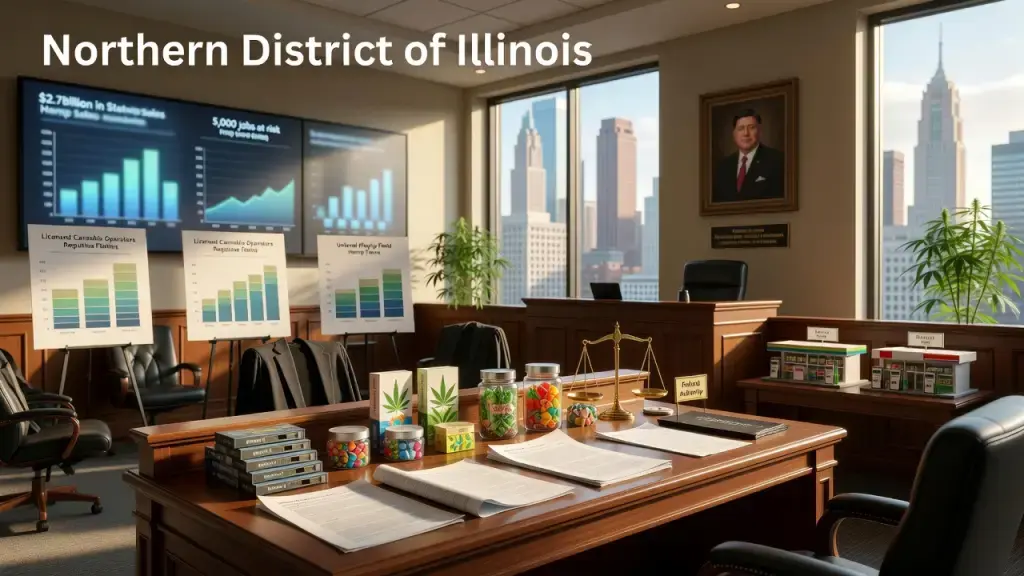
The Illinois Healthy Alternatives Association, along with several hemp operators, filed suit in the Northern District of Illinois seeking a temporary restraining order. Their core argument isn't about consumer safety or product formulation - it's about the commerce clause, the constitutional provision reserving interstate commerce regulation to Congress. The filing claims the state ban would "unconstitutionally slam shut access to Illinois markets by out-of-state companies," effectively cutting off a supply chain that runs well beyond state lines. That's a meaningfully different legal theory than a First Amendment or due-process challenge, and it puts the case on a track federal courts take seriously, even when they ultimately rule against the plaintiff.
How hemp THC got this big in the first place
Here's the mechanism worth understanding. The 2018 Farm Bill legalized hemp federally, defining it as cannabis containing less than 0.3% delta-9-THC by dry weight. The intent was straightforward: open the door for CBD, fiber, and grain markets, not intoxicating products. But chemists found workarounds. Delta-8-THC and similar isomers can be synthesized from CBD at scale, producing something that gets users high while technically satisfying the delta-9 threshold written into federal law. That loophole spawned an entire retail category operating largely outside the compliance architecture licensed cannabis businesses live under - no seed-to-sale tracking, no mandatory COA testing at the point of sale, no age-verification infrastructure resembling what adult-use dispensaries are required to maintain.
The association claims its members represent more than 250 businesses and 5,000 jobs, and cites an estimate from Whitney Economics putting hemp sales at $2.7 billion statewide - figures that, if accurate, would put unregulated hemp ahead of licensed cannabis in overall sales volume. That's the number licensed operators have been pointing to for years as evidence of an unlevel playing field: dispensaries absorb excise tax, 280E tax exposure, compliant packaging costs, and strict marketing limits, while hemp retailers selling similar intoxicating effects have faced comparatively little oversight.
Why this matters beyond Illinois
Licensed cannabis operators pushed hard for this kind of ban, and not without reason. Products sold without regulated packaging occasionally mimicked candy or snack branding, and the absence of age restrictions at many gas-station and convenience counters created real consumer-safety gaps - including documented instances of minors consuming hemp-derived THC products nationwide. A state ban would push that volume toward licensed retail, assuming consumers migrate rather than simply going without.
In practice, though, Illinois isn't operating in isolation. A federal hemp ban is scheduled to take effect Dec. 11, and advocates are lobbying to delay or soften it in favor of federal regulation rather than prohibition. If Illinois courts block the state law while the federal clock keeps ticking, retailers face a narrow, confusing window - compliant one month, shut down the next, depending on which jurisdiction's rule lands first. For wholesalers building delivery manifests and dispensaries adjusting their wholesale menus, that kind of regulatory whiplash is its own operational cost, regardless of which side ultimately wins in court.
Gov. Pritzker framed the state law as consumer protection - closing what he called an "intoxicating hemp loophole" while expanding medical access and bolstering social equity provisions in the licensed market. Fair enough, as policy goals go. Whether a federal judge agrees that Illinois can legally draw that line before Congress finishes drawing its own is now the question actually in play.